
Home / Sustainability at Truma
Sustainability at Truma
Caravanning and a passion for nature belong together.

At Truma, we take a long-term view and are implementing targeted measures relating to energy, resources, staff and corporate governance at our Putzbrunn site.
Sustainability explained
The concept of sustainability can be divided into three key areas: environmental, social and governance. Taking these so-called ESG issues into account forms the basis for responsible corporate governance.
Below, we present a selection of measures – both those already implemented and those currently underway – relating to energy, resources, employees and corporate governance at our Putzbrunn site. In doing so, we aim to demonstrate the successes we have already achieved and the areas where we still plan to make improvements.
Environmental
Energy demand

Solar energy
Electricity has been generated from solar energy at the Putzbrunn site since 2005 through the installation of photovoltaic systems. Photovoltaic systems with a capacity of approximately 650 kWp are installed at the Putzbrunn site.
E-mobility
To reduce CO₂ emissions caused by fuel consumption in its vehicle fleet, Truma has been committed to e-mobility since 2015. In 2024, approximately 10 per cent of the vehicle fleet consisted of fully electric or hybrid vehicles. In the pool vehicle fleet, this proportion stood at 25 per cent. In addition, electric charging points are available to our staff so that they can charge their private or company electric vehicles using 100 per cent electricity from renewable energy sources.
Emissions
Our site-specific energy procurement focuses on reducing direct (Scope 1) and indirect (Scope 2) CO₂ emissions. In addition to ensuring the most efficient use possible and the associated reduction in energy demand, we are committed to using renewable energy.
Electricity procurement
The electricity procured externally for the Putzbrunn and Unterschleißheim sites was, for accounting purposes, covered 100 per cent by electricity from renewable energy sources in the calendar year 2025.
Heat supply
In order to reduce CO₂ emissions from heat generation at our Putzbrunn site, we will be switching to district heating for the majority of our buildings from 2027. The construction work required to connect to the Stadtwerke München district heating network – which is supplied, amongst other things, by geothermal energy – was carried out in 2025 and 2026. The first heat supply took place in October 2026. Through the switchover from the current natural gas to district heating, we expect a reduction in CO₂ emissions of around 500 tonnes of CO₂ equivalents per year. The actual figure depends primarily on the heat demand and the actual composition of the district heating network in the reference year.
Resource use

Rainwater collection
Rainwater collected on site is stored in two large cisterns (with capacities of 4,000 l and 5,000 l). Depending on the amount of rainfall, this allows around 225,000 litres of rainwater (average for 2022 & 2023) to be used annually as greywater for flushing in the sanitary facilities, thereby saving precious drinking water
Reduce, reuse, recycle
First and foremost, Truma always strives to reduce its own consumption of resources and the volume of waste it generates, or, where possible, to reuse resources. Furthermore, the use of plastic packaging materials is largely avoided. Truma instead relies predominantly on cardboard packaging, which, for example, accounted for around 90 per cent by mass of the packaging waste placed on the market by Truma in Germany in 2023.
Service and repair
Truma is renowned for its excellent service and works with around 1,000 service partners across several countries. Furthermore, we offer our customers additional options for optimal service through our own mobile service technicians and the service workshop at our headquarters in Putzbrunn. In addition, we offer training courses for our dealers and service partners via our own Truma Academy to optimise repairs in the field.
Products

Approvals & product compliance
By having our products tested for conformity with the low-voltage directives (2014/35/EU) and EMC directives (2014/30/EU) by renowned institutes such as TÜV Süd, VDE, Intertek and SGS, we ensure that our products not only meet safety requirements in terms of electrical safety and electromagnetic compatibility, but also contribute to sustainability through their durability. At the same time, by certifying the components of our water systems in accordance with the Drinking Water Directive (EU) 2020/2184, we are making a significant contribution to protecting health by ensuring that the materials used do not contain any harmful substances that could otherwise enter the water circulation.
Reducing emissions from products
During product development, Truma takes various approaches to reducing greenhouse gas emissions into account. For example, our CombiNeo achieves an efficiency of 83 per cent when heating water, which is 8 percentage points above the standard requirements (standard EN 15033:2006 requires a minimum of 75 per cent – valid until 12 October 2026). The CombiNeo also significantly exceeds the required efficiency of 83 per cent (standard EN 624:2011 – valid until 12 October 2026) for space heating, achieving 90 per cent. Furthermore, when using the electric heating function, no direct combustion emissions are produced by the appliance. Indirect emissions from electricity generation depend on the electricity mix used. Furthermore, Truma diesel heaters are also approved for operation with XtL/HVO fuel, provided that the vehicle manufacturer has also granted approval for this fuel. Another indirect source of greenhouse gases is synthetic refrigerants in air-conditioning systems. In the event of faults in the cooling circuit or improper disposal, these can be released into the environment and cause considerable damage there. That is why, in the Aventa 2nd Generation, we use the natural refrigerant R290. Its GWP100 is 0.02 in accordance with the F-Gas Regulation (Regulation (EU) 2024/573 of the European Parliament and of the Council of 7 February 2024).
Electrification of heaters
Since the 1990s, the Truma product range has included hybrid heating systems that can combine fossil fuels and electricity as energy sources. We will continue to do so in future, because we believe e-mobility and camping go hand in hand! That is why we are developing various heating concepts to be prepared for potential future applications and to be able to further reduce the use of fossil fuels.
Product longevity
Another integral component of our product development is our “Design for Repairability”. In order to meet our own as well as the legal requirements for product repairability, an interdisciplinary team from our development, repair and service departments gets to work right from the product creation stage. After the market launch, we offer training for our specialist dealers and service partners through our own training department to enable product repairability in the field. Last but not least, we even ensure spare part availability for up to 20 years for certain products, over and above the legal requirements.Social
Employees
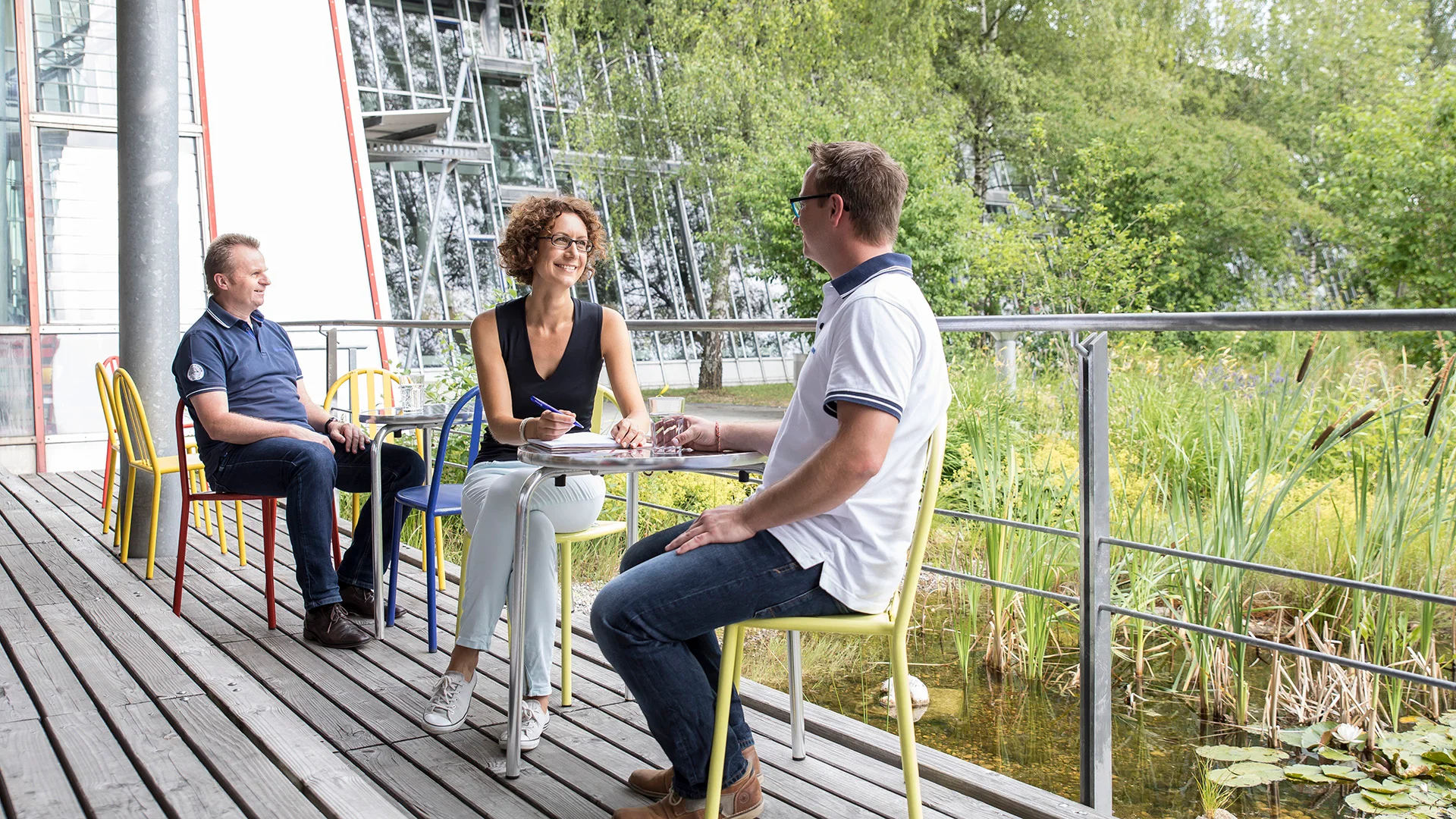
Take care health programme
Truma helps make its working environment and organisation conducive to good health through its occupational health management programme. It achieves this through various events and sporting activities as well as information on ergonomics in the workplace, stress, and the dangers of addiction. We also offer our employees a healthy diet with regional produce, outstanding quality and plenty of variety in our company restaurant.
Future Work concept
This work concept, which made it to the final round of the HR Excellence Awards 2022, demonstrates Truma’s future viability in the HR sector. The concept offers Truma employees the opportunity to use the most suitable working conditions for their individual needs, whether that is on site, remote or hybrid. This makes it even easier to combine work and family life, and employees can even take a ‘workation’ for up to 20 days within the EU.
TOP employer
Not least due to the measures described above, Truma has already been recognised several times as one of the TOP employers in the German SME sector. This is also reflected in the numbers: The average length of service is around 10 years and Truma employs people from over 30 different nationalities.
Truma foundation

The Truma owner family established the Renate Schimmer-Wottrich foundation in 2011. Since then, the foundation has supported charitable causes every year with a focus on helping children, young people and families in the greater Munich area. The aim is to provide socially disadvantaged families in particular with care, support and prospects for the future. Further information can be found on the foundation’s homepage.
Gouvernance
Corporate management

Code of Conduct
The Truma Code of Conduct sets out our expectations for all employees as well as our suppliers. In it, we lay down rules for ethical, legal and compliant behaviour and commit ourselves and those working with us to comply with these guidelines. In addition to many other measures, our Code of Conduct is a key element in fulfilling our responsibility in the supply chain.
EcoProfit (Ökoprofit) participation
Truma has been part of the Ökoprofit energy efficiency and climate protection network in Munich for many years. This facilitates regular discussions to share experiences, suggestions and measures around energy efficiency and climate protection.
Whistleblower Tool
The Whistleblower tool set up by Truma in accordance with the Whistleblower Protection Act gives employees, customers, suppliers and other affected parties a way to draw attention to grievances. This allows us to create even more transparency and to fulfil our corporate responsibility.
Management systems
A key element in achieving continuous improvement in operations is the introduction and maintenance of various management systems. For the companies, sites and scopes of application listed in the linked certificates, Truma operates management systems for energy (DIN EN ISO 50001), the environment (DIN EN ISO 14001), as well as for quality (DIN EN ISO 50001), and information security (DIN EN ISO 27001) and maintained.